I’m often asked by funders, partners, and peers in the education and technology space—how SIMA Academy is “using AI.”
It’s an understandable question. Across education, AI has shifted from innovation to expectation, from experiment to survival mode. Platforms are increasingly judged by how quickly they integrate it, how efficiently they deploy it, and how fluently they speak its language.
But for us, the more urgent question is a different one.
We’re past the moment of novelty. Artificial intelligence is already woven into classrooms, lesson plans, grading debates, faculty meetings, and student workflows. Everyone in education knows this. Students generate drafts in seconds; educators experiment, revise norms, and adapt expectations. The real question now isn’t whether AI is being used. It’s what kind of learning is taking place because of it.
Across contexts—from Palo Alto to Islamabad—the outputs often look impressive. Clear structure. Confident tone. Polished language. And yet many educators are describing the same unease: a widening gap between what can be produced and what can be understood.
We have entered a moment where expression is easy—but discernment is not.
This isn’t a technological crisis. It’s a pedagogical one. When the mechanics of making something become frictionless, the work of interpretation, judgment, and ethical reasoning becomes more—not less—important. What’s driving this gap isn’t just new technology, but an older habit intensified by it: our reliance on metrics—rubrics, benchmarks, and dashboards—to stand in for understanding.
Digital literacy and performance metrics have their place, but when we allow them to substitute for understanding rather than support it, learning becomes fragile.
From where I sit at SIMA Academy, this is the inflection point. Not a rupture, not a panic—but a choice. Education can chase speed, or it can reclaim depth. It can optimize the engine, or it can teach students how to hold the compass.
This choice becomes more urgent as generative AI accelerates the circulation of information. We are surrounded by more content than ever, but less shared ground for understanding it. Context is stripped away. Images travel without provenance. Narratives move faster than accountability.
The challenge for educators now is not just what students know, but how they come to know it. In an AI-shaped environment, the ability to interrogate sources, recognize framing, and understand how the medium itself shapes meaning is no longer enrichment. It is civic infrastructure.
This shift is already being signaled by global benchmarks. The OECD’s inclusion of Media and Artificial Intelligence Literacy (MAIL) in the 2029 PISA assessment reflects a deeper recognition: if our systems can only measure outputs, they will fail to capture judgment. A student who cannot interrogate the algorithm is not truly educated; they are merely a passenger on a ship they cannot steer.
This is exactly where our work at SIMA Academy begins. We exist to train these capacities at scale.
We don’t start with the question of how to integrate AI faster. We start with a more foundational one: What do learners need in order to think clearly, ethically, and independently in a media-saturated world?
Our answer has been consistent. Learners need vetted, human-made storytelling—taught not as content to absorb, but as a medium to interrogate.
Documentary film occupies a singular position in this moment. It sits at the intersection of art, ethics, journalism, and lived experience. Unlike synthetic media or automated summaries, documentary demands attention and interpretation. It asks learners to examine perspective, sourcing, framing, power, and omission. It exposes the mechanics of narrative rather than hiding them. In other words, it makes the medium visible.
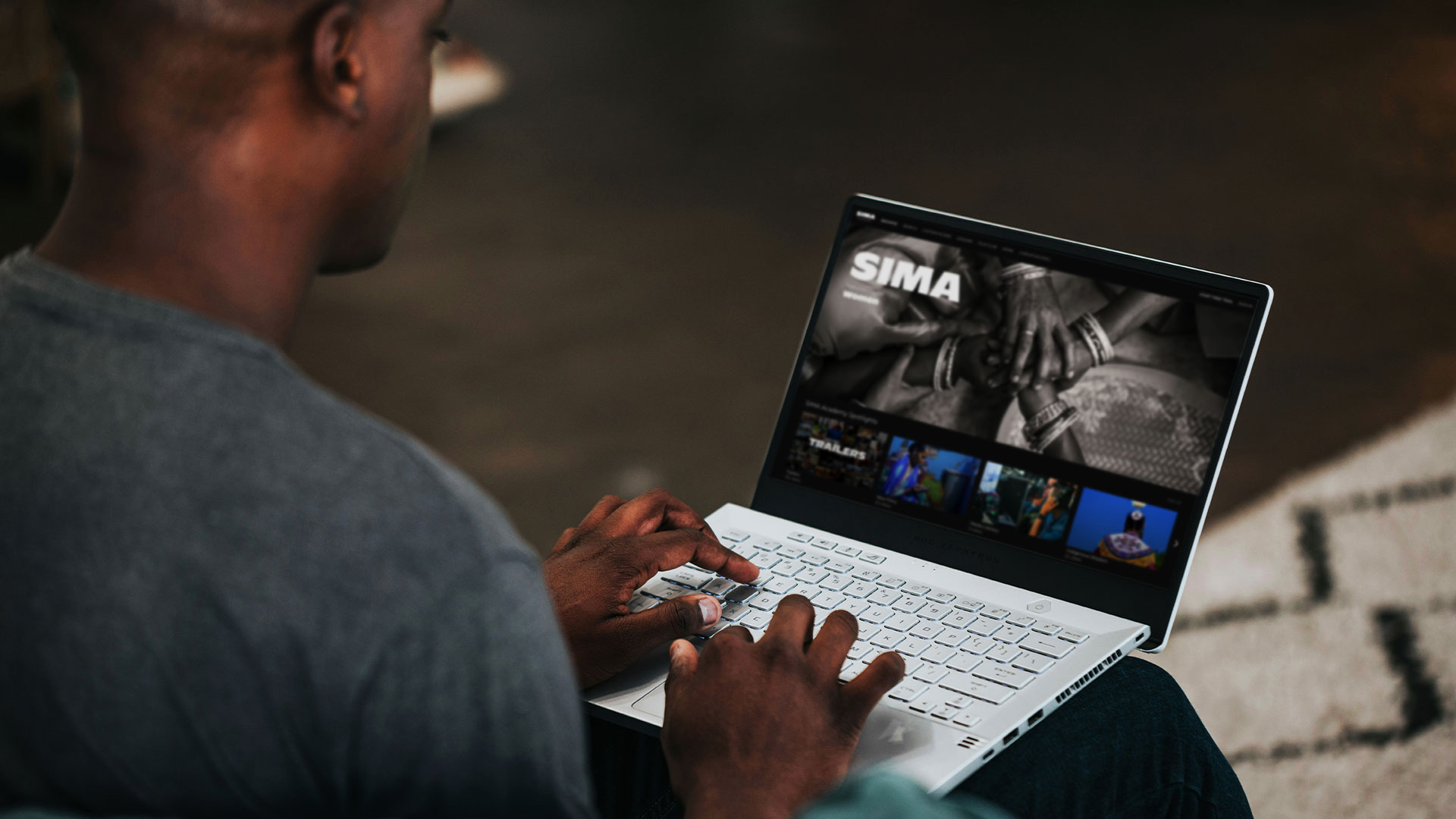
At SIMA Academy, we curate short-form documentary films from around the world with inquiry-driven learning frameworks that turn viewing into critical engagement. This focus on short-form is intentional. In a fragmented attention economy, these films create shared moments of focus without sacrificing depth.
Equally important is their global scope. At a time when AI systems are trained on uneven and biased information monopolies, global documentary storytelling preserves the jagged edges of lived experience that resist flattening and simplification. These stories complicate dominant narratives and invite learners to practice perspective-taking with discernment, not sentimentality.
Across our network, films become launchpads for action. Students don’t simply critique media; they respond to it—hosting screenings, leading discussions, and testing ideas within their own communities. Learning moves from abstraction to application.
Media today is rightly understood as a risk: a vector for manipulation, acceleration, and distortion. But it is also one of our most powerful tools for rebuilding trust—if handled with care.
At SIMA, we treat curation as a moral act. Each film on our platform is selected not only for its integrity, but for its capacity to broaden perspective, and is paired with tools that slow learning down enough for meaning to take hold. The capacities we prioritize—discernment, ethical reasoning, and civic imagination—are among the hardest to standardize, automate, or score, and yet they are the most essential for democratic life.
The urgency is unmistakable. Across 140 countries, we see a groundswell of demand—not for more content, but for more clarity. Educators are no longer asking for faster answers; they are seeking guidance on how to know, what to trust, and how to decide what matters. In an age of digital noise, the most valuable resource we can provide is a protected space for deep inquiry.
Ultimately, readiness for an AI-shaped world cannot be measured by technical fluency alone. It must be measured by a learner’s ability to interpret media, question narratives, and anchor decisions in human values. Those capacities cannot be automated.
The engine is running and our responsibility is to ensure students aren’t just passengers. They must be the drivers.
Written by Daniela Kon Lieberberg, CEO, SIMA
This essay benefited from AI-assisted copyediting. All arguments remain stubbornly human.